
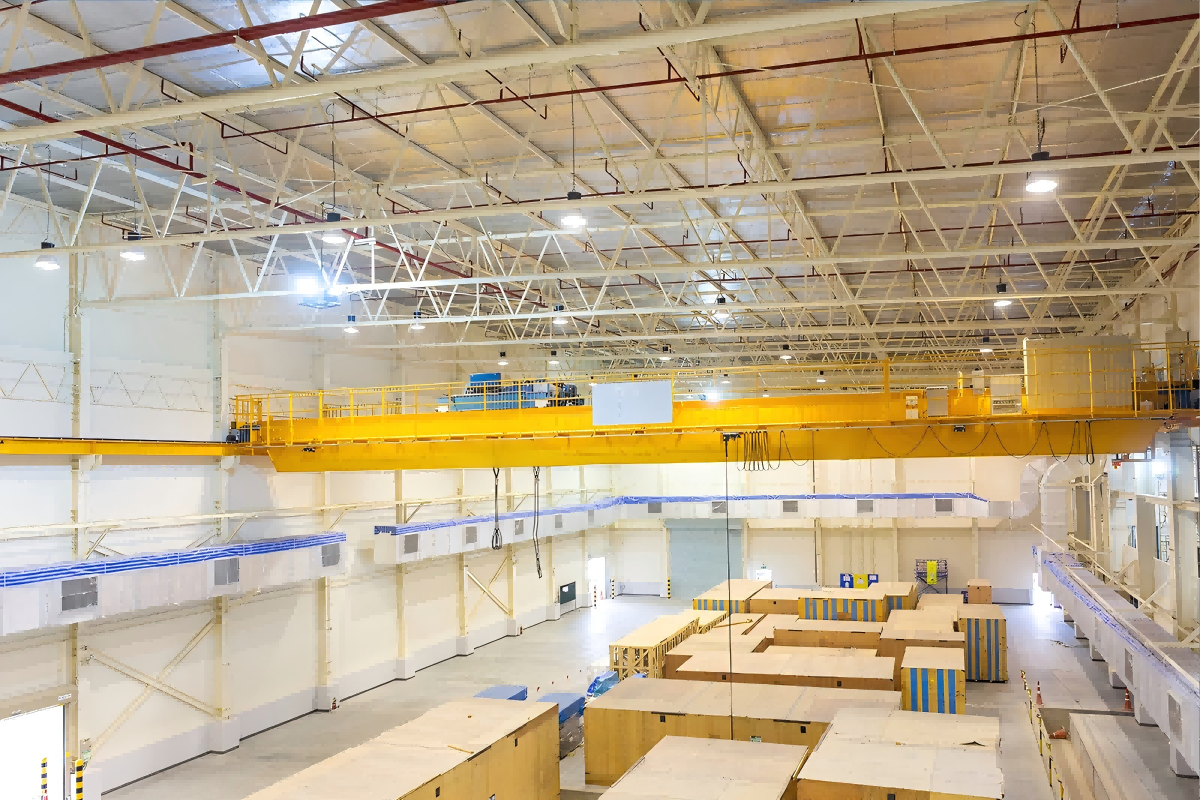
In the modern industrial landscape, the Industrial EOT (Electric Overhead Traveling) Crane serves as the primary engine for material handling efficiency. As global manufacturing transitions toward "Industry 4.0," these cranes have evolved from simple mechanical lifters into sophisticated, data-driven systems. Achieving operational excellence in 2026 requires a deep understanding of international engineering standards—such as CMAA Specification #70, FEM 1.001, and ISO 4301—as well as the integration of advanced drive technologies and structural material science. This guide provides a comprehensive technical analysis of industrial EOT cranes, supported by the latest market data and engineering benchmarks.
1. Structural Engineering and Material Science
The reliability of an industrial EOT crane begins with its structural integrity. The choice of materials and the precision of fabrication directly impact the crane's lifespan and safety.
1.1. High-Strength Steel: Q345B Manganese Steel
The primary structural component of a high-performance EOT crane is Q345B Manganese Steel (equivalent to ASTM A572 Grade 50). This low-alloy, high-strength steel is selected for its superior yield strength of 345 MPa and excellent weldability. To ensure long-term resistance to industrial corrosion, the steel undergoes Sa2.5 grade shot blasting (ISO 8501-1), followed by a multi-layer epoxy coating system with a minimum Dry Film Thickness (DFT) of 120μm. This process substantiates the "high-quality" claim by providing a protective barrier that prevents oxidation in humid or chemically active environments.
1.2. Deflection Limits and Geometric Stability
Adherence to CMAA Specification #70 is the benchmark for structural design. For industrial EOT cranes, the maximum vertical deflection is strictly limited to L/888 for single girder and L/1000 for double girder designs [1]. These tolerances are maintained through CNC underwater plasma cutting, which minimizes the heat-affected zone (HAZ) and ensures a girder camber accuracy of ±1mm. All primary tension welds are performed using Automatic Submerged Arc Welding (SAW), conforming to ISO 5817 Level B, and are subjected to 100% Non-Destructive Testing (NDT).
2. Advanced Drive Technology: The VFD Revolution
The integration of Variable Frequency Drives (VFDs) has transformed EOT crane performance, moving away from traditional contactor-based "step" control to smooth, infinitely variable speed management.
2.1. Precision and Efficiency
By utilizing VFDs from industry leaders like Schneider, Yaskawa, or Siemens, industrial EOT cranes achieve:
• Millimeter-Level Positioning: Accuracy within ±2mm, essential for precision assembly and mold handling.
• Soft-Start/Soft-Stop: Reducing mechanical shock loads on gearboxes and motors by up to 40%, which significantly extends the Mean Time Between Failures (MTBF).
• Energy Optimization: Regenerative braking and optimized motor torque curves can lead to energy savings of up to 30% compared to standard AC drives [2].
2.2. Anti-Sway and Smart Features
Modern EOT cranes incorporate electronic anti-sway technology. By calculating the pendulum effect based on rope length and acceleration, the VFD automatically adjusts the bridge and trolley speeds to stabilize the load. This reduces the risk of collisions and allows for faster cycle times, directly increasing facility throughput.
3. Global Standards and Duty Classifications
Selecting the right EOT crane requires matching the equipment's design to its intended service intensity.
Standard | Light Duty (Standby) | Moderate Duty (Workshop) | Heavy Duty (Continuous) |
CMAA | Class A / B | Class C / D | Class E / F |
FEM | 1Am / 1Bm | 2m / 3m | 4m / 5m |
ISO | M3 / M4 | M5 / M6 | M7 / M8 |
Note: Most industrial workshop EOT cranes are designed to CMAA Class D or FEM 2m, supporting up to 10-20 lifts per hour at 50% of rated capacity [3].
4. Market Outlook and Future Trends (2025-2030)
The global industrial crane and hoist market is projected to grow from $34.68 billion in 2025 to $41.56 billion by 2030, at a CAGR of 3.7% [4]. This growth is driven by:
• Automation and IoT: The adoption of "Smart Cranes" equipped with sensors for predictive maintenance, which can reduce unplanned downtime by over 25%.
• Safety Compliance: Increasing regulatory pressure for advanced safety features, such as infrared anti-collision sensors and electronic overload limiters with ±5% accuracy.
• Sustainability: A shift toward lightweight "European-style" designs that reduce the deadweight of the crane, thereby lowering the structural requirements and energy consumption of the host building.
5. Conclusion: A Strategic Industrial Investment
An Industrial EOT Crane is a long-term capital asset that defines the productivity of a facility. By prioritizing Q345B structural integrity, VFD-driven precision, and strict adherence to CMAA/FEM standards, industrial operators can ensure they have a lifting solution that is safe, efficient, and future-proof. In the competitive landscape of 2026, the right EOT crane is not just a tool—it is a strategic advantage.